
Discover why addressing compassion fatigue in frontline social workers is a critical capacity risk. Explore how yoga, pranayama, and wellness built into institutional CSR funding secure sustainable social impact.
During my time working as an officer of the administrative service in Ballari district in Karnataka, I had the good fortune of being introduced to one of the strongest, most daring and relentless women I have ever met in my life. She had committed her life to serving the cause of rehabilitation and empowerment of the Devadasi women population, predominantly in the Kalyana Karnataka belt, but she also championed the cause across several states. When I visited the project site – where Devadasi women were being brought back into the mainstream by offering agriculture and dairy farming as alternate means of livelihood – the effort and commitment it took to make it happen was very evident and the hope rekindled in the eyes of the young girls was a truly moving experience. With a heart full of warmth and love, and with renewed vigour to keep doing good work despite odds, I returned to my role.
Almost half a decade later, when I met her once again in my renewed capacity as an advisor to NGOs for capacity building through Aikya, I heard from her that the project I had visited several years ago had failed due to a lack of support from locals and in some cases a lack of conviction among the women beneficiaries to stay the course during hardships. Nonetheless, she mentioned other successes, one of which was the passing of the Karnataka Devadasi (Prevention, Prohibition, Relief and Rehabilitation) Bill, 2025, by the Karnataka Government, which was a milestone in their journey of fighting for these women’s rights. While she remained unfazed by the failure of a project into which they had poured several years of effort, time and money, I could not help but wonder about the amount of resilience it took to keep going back to a challenging cause – possibly un-addressable in one’s lifetime – over and over again with the same will and determination. I also pondered the immense mental toll this sort of an endeavour takes, even when it is one’s true calling.
That got me thinking about one of the many paradoxes in the social sector: those who spend their lives carrying the burdens of marginalized communities often carry the heaviest unaddressed mental health burdens themselves. Frontline social workers, NGO field staff, and community leaders face the risk of chronic, systemic burnout every day, when they step out to perform their duties, even when it is their true calling. Secondary traumatic stress from being indirectly exposed to another person’s traumatic experience, and Compassion Fatigue from the exhaustion of having to go back to this stress over and over again, can feel like a part of the role they willingly signed up for. Burnout is not an individual failure; it is an institutional capacity risk. To scale social impact, we must first sustain the impact-makers.
This missing link in capacity building is where integrating foundational yoga, pranayama (breathwork), and mindfulness into organizational structures becomes a strategic necessity, not just a workplace perk.
The cost of grassroots burnout
The reality of working in the not-for-profit sector is often hidden behind admirable photos of happy end-beneficiaries and numbers projected well in social impact studies. The true picture that grassroot workers often sign up for involves long hours of work involving heavy emotional labour, while managing complex socio-economic realities and battling for best results amidst resource constraints.
To draw a parallel with similar high-stress job profiles, emergency workers and firefighters operate within a closed crisis loop. They arrive at a scene, stabilize the patient or put out the fire, and exit. The event has a definitive end. In contrast, social workers live in an open-ended crisis loop. They absorb a family’s multi-generational trauma, navigate deep-seated systemic failures, and must return to the exact same environment the next morning. Their stress accumulates gradually rather than spiking sharply. They do not get to leave the scene after the emergency is over; they return to it daily. This distinct, chronic emotional burden requires targeted mind-body resilience strategies to protect our change-makers from breaking down.
The result of letting this stress go unaddressed often creeps in as high staff attrition, declining empathy in field execution, reduced program efficiency and friction in community engagement. Just like the fatigue that slowly builds up over time, the failure of an intervention also slowly seeps in, often untraceable to any specific hard-hitting cause. While assessment metrics typically look into qualifications of staff and their proficiency in managing stakeholders on ground, a slow-growing reason such as this often goes undetected. While NGOs train staff on compliance, data collection, and project management, they rarely build capacity for emotional resilience and nervous system regulation.
Science of Resilience for Social Workers
For frontline workers who operate in an open-ended crisis loop, the trauma they witness is continuous and their body never receives the “all clear” signal. The brain keeps the sympathetic nervous system perpetually turned on, locking the worker into a state of chronic hyper-vigilance. When the body is trapped in a perpetual fight-or-flight state, it undergoes a biological process called cortical hijacking. This directly impairs decision making and eviscerates empathy. However, targeted practices can stimulate the vagus nerve, activate the parasympathetic nervous system, and restore cognitive and emotional balance. This is where our ancient science of ‘Yoga’ comes in.
The word ‘Yoga’ often brings to mind images of physical postures – often complex but aesthetic – which is definitely an undeniable part of yoga. But moving away from the narrative of asanas allows yoga to become an accessible science of inner wellbeing. The astounding simplicity of a breath well taken, to full capacity, with awareness of bodily movement while exhaling mindfully, is truly underestimated. The breath, or prāna as it is called in yoga, is deeply connected to the mind. It is literally the steering wheel controlling the direction of the mind. It really does not take much for NGOs to weave a few basic elements into their operational structures to benefit their staff, and their organisations in the long run.
- 1. Micro-Pranayama (Breathwork) for Field Transitions
- The Practice: Implementing 3-to-5-minute breathing techniques (like Nadi Shodhana / Alternate Nostril Breathing or Box Breathing) before entering high-stress field situations or right after crisis management.
- The Benefit: Immediate reduction in acute cortisol spikes, resetting emotional baselines between community visits.
- 2. Mindfulness as a Tool for Secondary Trauma Processing
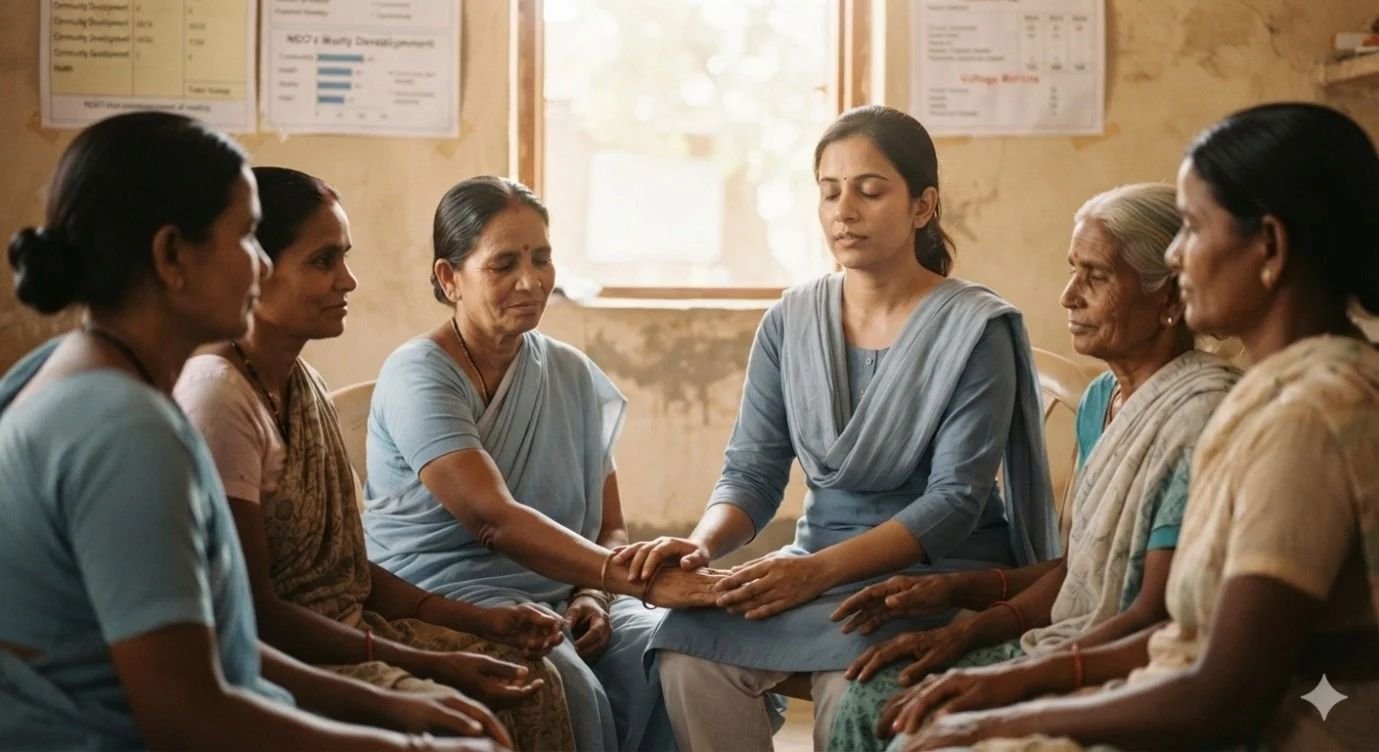
- The Practice: Structured end-of-week reflection circles using basic mindfulness frameworks (Sakshi Bhava or non-judgmental witnessing).
- The Benefit: Allows change-makers to compartmentalize and safely release the trauma they witness daily, preventing it from turning into long-term psychological fatigue.
- 3. Restorative Poses for Desk and Field Workers
- The Practice: Simple, accessible stretches that require no equipment, focusing on releasing physical tension held in the neck, shoulders, and lower back from long travel or desk hours.
A specialized study published in Journal of Evidence-Informed Social Work evaluated a targeted yoga and mindfulness program specifically for actively employed social workers. Using the Professional Quality of Life (ProQOL) scale, researchers found that even a brief, structured yoga and mindfulness intervention successfully halted the decline of compassion satisfaction. Furthermore, the qualitative data showed that social workers experienced a massive improvement in how they perceived and managed relationships with “difficult” or highly traumatized clients.
Science confirms that we cannot think our way out of burnout. Research tracking human service professionals shows that mind-body interventions like simple pranayama and restorative yoga don’t just feel good—they clinically lower cortisol, halt compassion fatigue, and protect the empathy of the serving hands of our organizations. Workplace wellness isn’t a luxury; it’s evidence-based capacity building.
Restoring the source of the impact
Most corporates are exceedingly professional in handling their CSR funds, mapping KPIs to every rupee spent. All contributions have to translate into tangible, scalable societal value. However, a systemic blind spot exists in the funding ecosystem: corporate donors heavily focus on external metrics —such as literacy rates, medical distributions, or check-dams built—while ignoring the very humans that make these metrics possible. When corporate funders ignore the psychological safety and emotional resilience of implementation partners, they actively endanger their own investments. Healthy, emotionally regulated change-makers lead to higher trust within communities, cleaner data collection, and long-term project sustainability. Thus, it is not only ideal but also profitable for corporations to fund not just the end outcomes of a change but also the medium through which this change is being made. True social transformation cannot be achieved via an exhausted change-maker. The silent crisis of grassroots burnout is not an individual weakness to be managed by personal self-care; it is a critical structural vulnerability that compromises the integrity of the entire social sector. At Aikya, we always focus on the interconnectedness of the entire ecosystem. Viewing problems in isolation will only deliver partial solutions. A holistic approach to a problem offers a comprehensive resolution. Oneness and structural synergy are vital to view external impact of an organisation as not being different from the internal health of its people. After all, people can only give what they carry.
